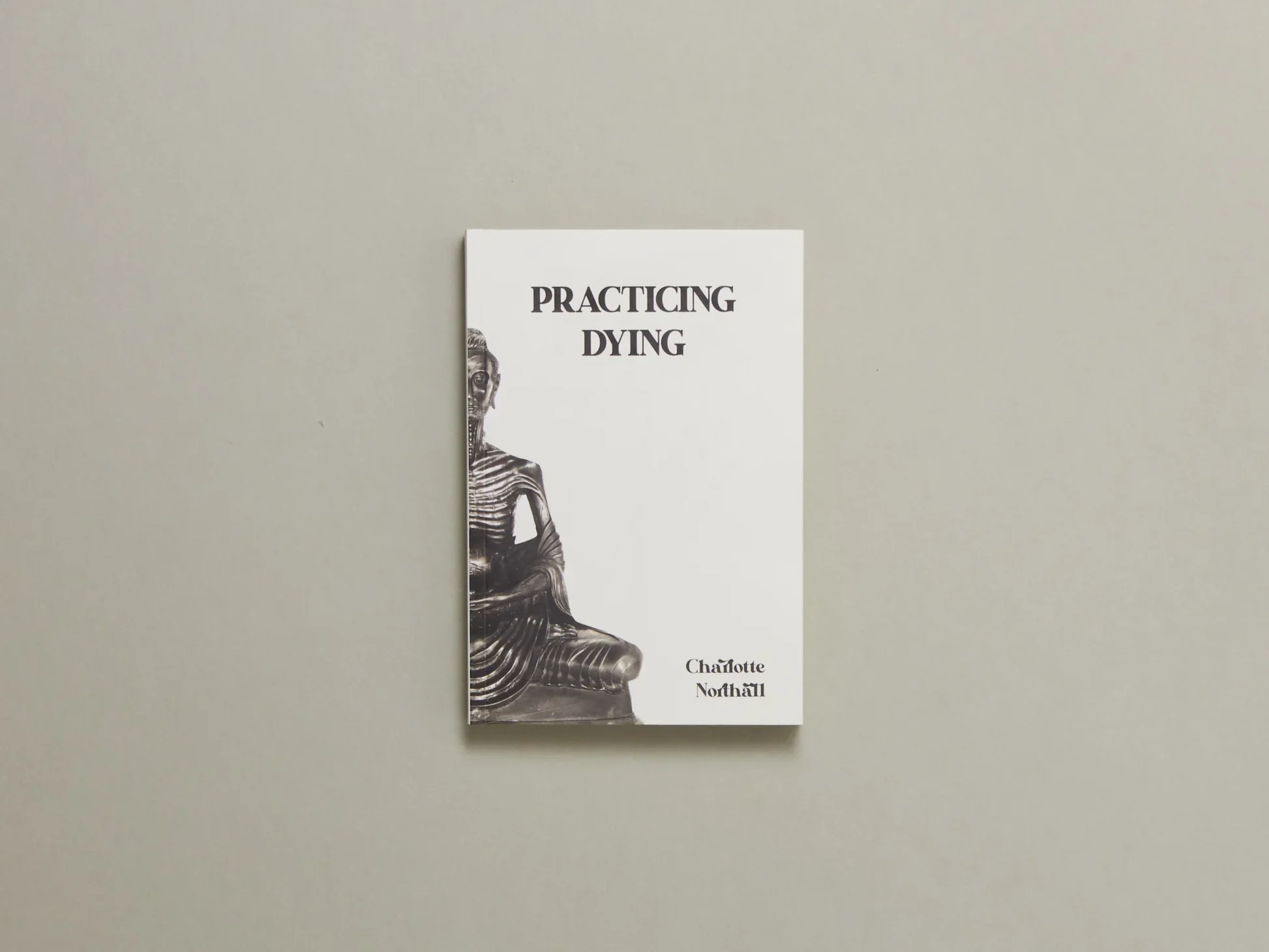
Pilot Press, 2025 · Literary anti-memoir
Practicing Dying
A Times Literary Supplement Book of the Year
‘Practicing Dying is brilliant, rewarding and difficult. Northall offers the most brazen and shocking account of addiction I’ve ever read. Committing herself to the practice of Mahayana Buddhism, she eventually finds a way out, but only on the most rambling, circuitous path. Her account of addiction and loss, displacement and grief is profound and it proves that nothing is ever one thing.’
— Chris Kraus
A radical literary account of addiction, consciousness and survival.
Practicing Dying is a literary anti-memoir documenting life in a Zen Buddhist monastery in rural France where the protagonist, a woman in her late twenties, attempts to overcome chronic drug addiction and mental illness.
Broken and severely unwell, our protagonist arrives at the monastery from London: starving, drug-addicted and disillusioned, having exhausted every conventional treatment route available to her. The book examines how, habituated to a life of benefits assessments, petty-crime and sex work, she struggles to adjust to the rules, discipline and religious life of the monastery—at times to devastating and comedic effect.
As the story unfolds, she reflects on her addictions and past experiences, raising critical questions about what it means to be "an addict" and why there may be vested corporate and societal interests in maintaining a narrow, individualistic understanding of addiction.
Anarchic and provocative, tender and self-deprecating, Practicing Dying differs from other contemporary memoirs in the genre of addiction-recovery by simultaneously challenging the dominant narratives surrounding mental health while proposing an alternative approach to treating the “sickness of self” from which we all increasingly suffer.
Availability
Practicing Dying is available from independent bookshops and selected retailers.
Readers are encouraged to support independent bookshops where possible.
Pilot Press (preferred)
Critical Reception
‘The untamed offspring of Pema Chödrön’s The Wisdom of No Escape and David Wojnarowicz’s Close to the Knives, this is an addiction memoir that coolly refuses conventional narratives of addiction, trauma and recovery; an unflinching, no-holds-barred, seriously intelligent investigation into existence and how to survive it. A gut-wrenching, sublimely rewarding ride.’
— Olivia Laing
‘Charlotte Northall’s Practicing Dying is extraordinary. It had me holding my breath. She writes in the same direct and uncompromising vein as Heather Lewis and Shulamith Firestone about the darkest corners of experience. But hers is ultimately a story of survival and even transcendence, one earned on every page. The existence of the book itself is hope.’
— Nate Lippens
Further Praise
‘Irresistibly anarchic and painfully lucid in its self-savagery, Practicing Dying is very funny, deeply moving, and ultimately revelatory. Writing is for belonging to no-one, whilst living is revealed to be a much more complicated, relational, entanglement altogether. Wild and fearless—this is life writing at its messiest, teeming with incomfortable and often queasy affect. Exhilarating reading .’
— Nell Osborne
‘Step by step, Northall’s intellect transcends with detailed perceptions of both grace and misery. Practicing Dying is an original, dire and illuminated addition to addiction literature.’
— Eliot Duncan
‘Practicing Dying is the kind of book that I always hope will exists. It’s raw and personal, it’s dark and melancholy, it dissects culture and society and is also completely compelling and written with the precision skill of a spider laying out fresh gossamer.’
— Thomas Moore
‘The only addiction memoir you’ll ever need to read is this one… to say I was blown away by it would be the world’s biggest understatement… Practicing Dying is an unflinching, brutal (and brutally honest), subversive, raw and visceral account... This book can – and should – change lives.’
— Victoria Richards, The Independent‘
Bodily sensations come through so vividly… spanning restraint, pleasure, pain and desire… a visceral text concerned with embodiment and sensation.’
— Clem MacLeod, Worms Magazine
‘Difficult to contain in the category ‘novel’… comprising elements of essay, (anti)memoir, and confronting discussion… persistently revisit[ing] the relationship between social exclusion, the expression of intellect, and the need to read and write.’
— Will Aghoghogbe, Public Knowledge Books